Forget the limp, emerald-green paste of your childhood; we are here to re-engineer a classic into a high-octane masterpiece of culinary infrastructure. When you engage with a Spicy Pesto Pasta, you are not just making dinner. You are managing a volatile chemical reaction where the piquant heat of crushed red pepper meets the aromatic fragility of fresh basil. The goal is a viscous, velvet-coated noodle that grips the palate and refuses to let go. Most home cooks fail because they treat pesto as a passive sauce rather than an active emulsion. We are going to fix that. We are going to talk about capsaicin solubility, chlorophyll oxidation, and the precise mechanical shear required to create a stable suspension. This is about structural integrity. This is about the aggressive marriage of heat and herb. If your kitchen smells like a botanical garden under siege by a spice market, you are doing it right. Let us audit your station and prepare for the most intense Spicy Pesto Pasta of your professional life.
THE DATA MATRIX
| Metric | Specification |
|---|---|
| Prep Time | 15 Minutes |
| Execution Time | 10 Minutes |
| Yield | 4 Servings |
| Complexity (1-10) | 4 |
| Estimated Cost per Serving | $3.50 |
THE GATHERS
Ingredient Protocol:
- 500g / 1.1 lbs Dried Bucatini or Rigatoni
- 80g / 3 cups Fresh Basil Leaves (tightly packed)
- 60g / 0.5 cup Pine Nuts (toasted)
- 15g / 3 cloves Fresh Garlic (peeled)
- 10g / 2 tsp Crushed Red Pepper Flakes (high-grade)
- 120ml / 0.5 cup Extra Virgin Olive Oil
- 75g / 0.75 cup Parmigiano-Reggiano (finely grated)
- 45g / 0.5 cup Pecorino Romano (finely grated)
- 5ml / 1 tsp Fresh Lemon Juice
- 5g / 1 tsp Flaky Sea Salt
Section A: Ingredient Quality Audit:
The primary failure point in any Spicy Pesto Pasta is the quality of the lipids. If your olive oil tastes like cardboard, your pesto will follow suit. Audit your oil by tasting a spoonful; it should have a peppery finish that complements the red pepper flakes. If it is bitter or rancid, discard it. Secondly, the red pepper flakes must be vibrant. If they are dull brown, the capsaicin has degraded. To fix sub-par spices, toast them lightly in a dry pan for 30 seconds to wake up the volatile oils before they enter the blender or mortar. Finally, ensure your basil is bone-dry after washing. Residual water will break your emulsion and turn your sauce into a swampy mess.
THE MASTERCLASS

1. The Aromatic Base Construction
Place your garlic, toasted pine nuts, and red pepper flakes into a heavy mortar and pestle or a high-speed processor. Pulse until a coarse, sandy paste forms. You are looking to render the garlic into a smooth substrate that will carry the heat throughout the dish.
Pro Tip: Using a digital scale to measure your garlic ensures the allicin levels do not overpower the basil. The science of "crushing" versus "chopping" garlic is real; crushing ruptures more cell walls, creating a more intense, piquant flavor profile.
2. The Chlorophyll Integration
Add the basil leaves in three stages. If using a processor, pulse briefly to avoid heat friction, which oxidizes the leaves and turns them brown. You want to aerate the mixture slightly while keeping the temperature low to preserve the bright green hue.
Pro Tip: Professional chefs often blanch and shock their basil for two seconds in boiling water then ice to lock in the color. If you are skipping this, ensure your processor blade is chilled in the freezer for ten minutes prior to use.
3. The Lipid Emulsification
Slowly stream in the extra virgin olive oil while the motor is running or while vigorously stirring. This is where you create a viscous suspension. The oil must encapsulate the water content of the basil to prevent separation.
Pro Tip: Use a saucier to hold your finished pesto at room temperature. Never heat the pesto directly over high flames; the heat will destroy the delicate aromatic compounds of the basil and turn the sauce bitter.
4. The Starch and Protein Bind
Cook your pasta in highly salted water until it is two minutes shy of al dente. Reserve 250ml of the starchy pasta water. Transfer the pasta to a large mixing bowl, add the pesto, and slowly fold in the grated cheeses.
Pro Tip: Use a bench scraper to efficiently move your grated cheese from the cutting board to the bowl. The starchy water acts as a molecular bridge, helping the fats in the cheese and oil bond to the surface of the pasta.
Section B: Prep & Timing Fault-Lines:
The most common timing error is adding the pesto to a screaming hot pan. This results in "broken" pesto where the oil leaks out and the solids clump. To fix this, always toss the pasta and sauce in a separate, warm bowl. If the sauce is too thick, add the reserved pasta water one tablespoon at a time. The temperature of the pasta itself should be the only heat source used to melt the cheese and infuse the flavors. If your timing is off and the pasta cools too much, use a double-boiler method to gently bring it back to temperature without splitting the emulsion.
THE VISUAL SPECTRUM
Section C: Thermal & Visual Troubleshooting:
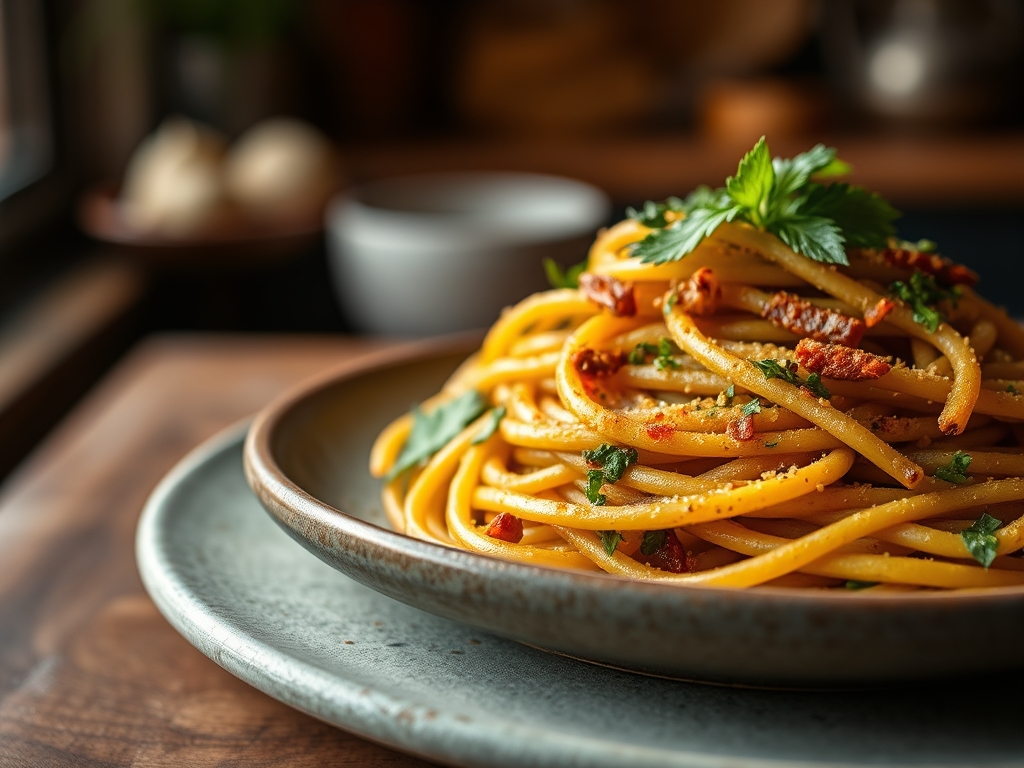
Referencing the Masterclass photo, your Spicy Pesto Pasta should exhibit a vibrant, neon-green hue punctuated by distinct flecks of crimson red pepper. If your dish looks dull or olive-drab, you likely overheated the basil during processing or let the pasta sit too long before serving. If the sauce appears "sweaty" or oily, the emulsion has broken; you can often fix this by adding a splash of pasta water and tossing aggressively to re-incorporate the fats. The texture should be "clinging" rather than "dripping." Look for that specific sheen in the photo; that is the sign of a successful starch-fat bond.
THE DEEP DIVE
Macro Nutrition Profile:
A standard serving provides approximately 650 calories. You are looking at a high-energy profile with 45g of carbohydrates, 35g of healthy monounsaturated fats from the olive oil and nuts, and 18g of protein from the hard cheeses.
Dietary Swaps:
- Vegan: Swap the cheeses for 30g of nutritional yeast and an extra 20g of toasted pine nuts for creaminess.
- Keto: Replace the pasta with zucchini noodles or shirataki strands. Ensure you do not boil the "noodles" or they will release too much water and ruin the pesto.
- GF: Use a high-quality brown rice or chickpea pasta. Be aware that GF pasta water is often starchier, so use less when thinning the sauce.
Meal Prep & Reheating Science:
Pesto is notoriously difficult to reheat because heat oxidizes the basil. If meal prepping, store the pasta and pesto separately. To reheat, bring the pasta to room temperature and toss with the cold pesto. If you must use a microwave, use 30% power to avoid "cooking" the sauce. The molecular structure of the fats will stabilize better if you add a fresh squeeze of lemon juice during the reheat to brighten the flavors.
THE KITCHEN TABLE
Why is my pesto bitter?
Over-processing the olive oil can cause polyphenols to break and release bitterness. Also, ensure you have removed the "germ" from older garlic cloves. Always pulse your processor; never let it run continuously.
Can I use walnuts instead of pine nuts?
Yes. Walnuts provide a deeper, earthier flavor but contain more tannins. Toast them thoroughly to mellow the astringency. The resulting Spicy Pesto Pasta will be slightly darker but equally delicious.
How do I make it even spicier?
Infuse your olive oil with the red pepper flakes for 24 hours before making the pesto. This ensures the capsaicin is evenly distributed throughout the lipid phase of the sauce, providing a consistent, lingering heat.
Why does the cheese clump?
You likely used pre-shredded cheese. These contain anti-caking agents like cellulose that prevent smooth melting. Always grate your Parmigiano-Reggiano and Pecorino fresh from the block for a seamless, velvet-like texture.